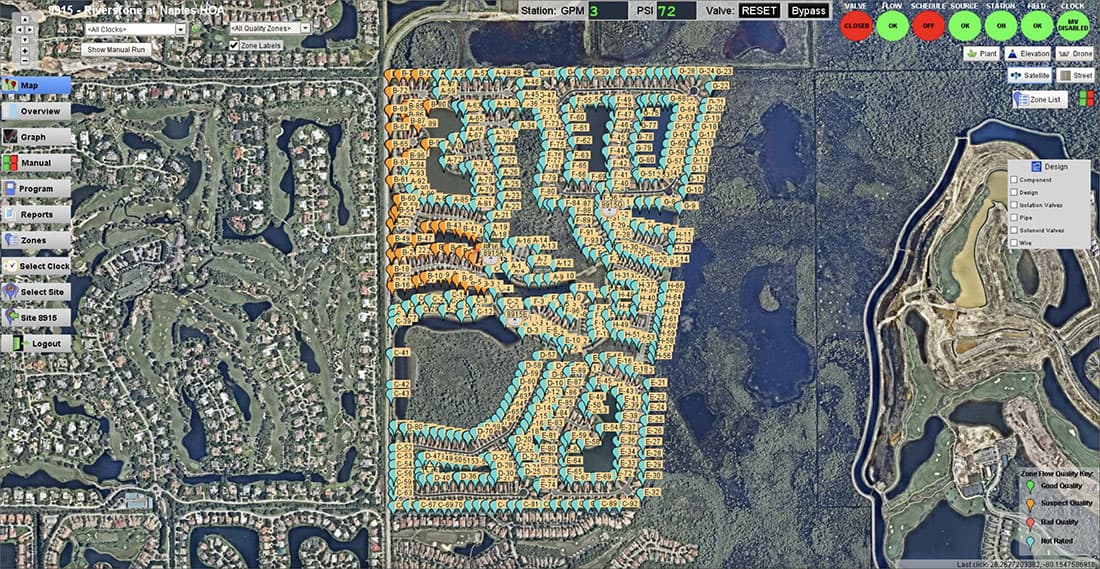
Working with a sub-optimal irrigation system is bad for the health of your landscape. It's also bad for the health and wellbeing of the HOA committee members who will, ultimately, end up trying to fix perennial problems - and wasting a ton of money while doing so.
For Riverstone, trying to work with their ill-designed irrigation pump stations proved to be all-but impossible in the long-term. In addition to spending vast sums of money on remedial work, they were spending thousands of dollars on water quality mitigation which later, once the plan was implemented, proved to be no longer necessary.
Ultimately, the pump stations cost the HOA a lot of money - resulting in a lot of damage to the development's landscaped green spaces. Prior to our being involved with the development, the landscaping committee was dealing with approximately 50 - 100 irrigation-related complaints every week.
Without completely replacing their pump stations, this situation was only going to get worse, and the Riverstone HOA knew that they were heading down a road that would necessitate tremendous investment.
But replacing the irrigation pump stations also proved challenging. The HOA needed to work out what was going wrong, and who they could trust to design a functional replacement.
It's Hard To Know Who To Trust
Making these decisions can be incredibly difficult. Everyone claims to know what's going wrong, but the overwhelming majority of pump station manufacturers and irrigation consultants are either misguided or unscrupulous in their approach; promising the earth and then failing to deliver a suitable solution.
We'd been part of (and privy to) the continuous back and forth between vendors and the board on this project since 2016 and had resolutely offered up the Hoover solution that would solve most of Riverstone's problems. Unfortunately, some members of the HOA board were also taking advice from third parties that were leading them down the wrong path.
As a result, their first attempt at commissioning a replacement backfired. Again, in the words of a board member, "they installed another half-baked pump station that was nearly as bad as the equipment it was replacing, and it burnt out multiple times in the first year."
In the end, this botched replacement work cost the HOA in excess of a staggering $6-figure sum - and opened the door to even more headaches.
A Considered Approach
We were brought back to the table, where we again made it clear that the only way to resolve the situation was to take a considered approach and deliver a substantial overhaul of the existing system.
Even with the ear of the board however, it still took time to persuade everyone that our remedy was the only way to break the perpetual 'break and fix' cycle that was draining the HOA's landscaping budget - and causing everyone so much stress. So much so, that the cost of the filtration system we knew they needed became another reason to put off a final decision; we were asked if a different filtration solution would work as well. We knew it wouldn't but the decision was taken to install the alternative on both stations - only to be ripped out and thrown away. We didn't waiver however. We knew our solution was the right solution and finally plans were set in motion.
The Decision-making Can be Unnecessarily Tortuous
Now, we think it's important to note that this situation isn't unusual: We know that it's tough to make decisions about something as expensive, important and complex as a community irrigation system. There's a definite learning curve to these things.
We also know that a lot of the people forced to make these decisions are beset - on all sides - by contradictory opinions and all manner of well-meaning (but misplaced) advice from third party contractors who are prone to suggesting endless 'fixes' that simply prolong the agony.
Inaction Can be Costly
But inaction can be incredibly costly too. In the Riverstone HOA's case, every day that they spent saddled with their old pump stations cost them money and the community's goodwill, which is why we held our ground, and continued to advise the HOA board to let us install an improved system that was capable of properly irrigating their development.