
Series: The Next Generation of Green: Florida's Guide to Intelligent Irrigation Reliability.
In our first two articles, we looked at the financial and operational toll that legacy irrigation systems take on communities across Florida, and at how real-time monitoring technology transforms the way those communities operate. Both articles pointed toward the same conclusion: the gap between a system that constantly breaks down and one that reliably performs is not a matter of luck. It is a matter of design.
In Part 3, we examine one of the most consequential design decisions in any modern irrigation pump station - the Variable Frequency Drive, or VFD. Understanding what a VFD does, why it matters, and how Hoover integrates it into every pump station it builds is central to understanding what genuine irrigation efficiency looks like in practice.
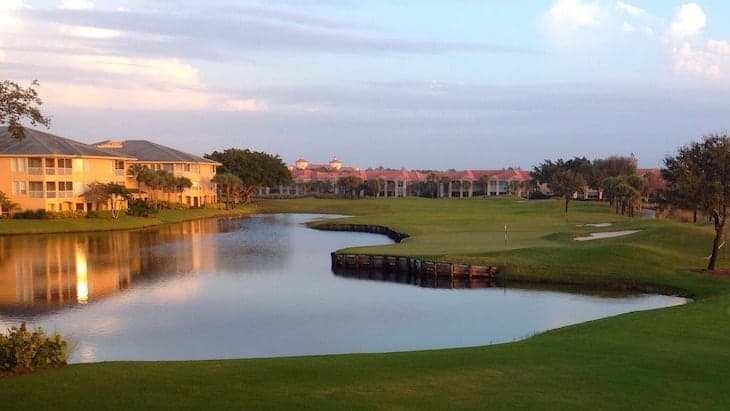
Most people who manage irrigation systems have never had reason to think much about motor startups. The pump comes on, the water flows, the system does its job. What happens in the moment the motor activates is largely invisible.
But in a fixed-speed pump system - the kind that still forms the backbone of a large proportion of Florida’s legacy irrigation infrastructure - that moment is anything but gentle. When a conventional motor receives its start signal, it goes from zero to full operating speed almost instantaneously. There is no ramp-up, no gradual acceleration, no consideration for the state of the system it is driving. The motor fires at full throttle, and a burst of high-pressure water travels through the mainline, placing immediate stress on pipes, joints, fittings, and hardware throughout the system.
This is water hammer - and in an irrigation environment where pump cycles repeat twice a night, every night, across years of operation, the cumulative damage it causes is significant. Pipes fatigue. Joints weaken. Components that might otherwise last for decades begin to fail ahead of schedule.
The pump motor itself fares no better. The thermal stress of repeated high-current startups degrades motor insulation and accelerates wear on internal components. The motor runs harder than it needs to, for longer than is necessary, because it has no mechanism to do otherwise.
None of this is an engineering failure. It is simply what fixed-speed motors do. The question is whether your pump station is designed to work around it - or not.
A Variable Frequency Drive is an electronic device that sits between the incoming power supply and the pump motor. Its function is to control the frequency and voltage delivered to the motor - and because motor speed is directly related to the frequency it receives, that means controlling exactly how fast the pump runs at any given moment.
In practical terms, a VFD does two things that a fixed-speed motor cannot.
First, it provides a soft start. Rather than firing the motor at full power the moment it receives a start signal, the VFD brings it up to speed gradually - ramping from zero to operating speed in a controlled, predictable way. The pressure surge that would otherwise travel through the mainline is significantly mitigated. The thermal spike that would otherwise stress the motor insulation does not occur. The system comes up to speed smoothly, and everything in it - pipes, fittings, motors, components - experiences a fraction of the mechanical stress it would under a conventional startup.
Second, it provides variable speed operation. Once running, the pump motor does not need to operate at the same speed regardless of demand. A VFD allows the motor to run at exactly the speed required to meet current conditions - faster when demand is high, slower when it is not. The motor only works as hard as it needs to, and no harder.
This matters enormously in an irrigation context, where demand is rarely constant. Water requirements vary across zones, across seasons, and across the course of a single irrigation cycle. A system with fixed-speed pumps has only one response to that variation: run at full speed regardless. A system equipped with VFDs can match its output to what the field demands at any given moment.
The consequences of fixed-speed operation for the landscape itself are worth spelling out, because they are not always immediately visible.
Without the ability to vary the volume of water being delivered through the system, a fixed-speed pump operates on a relatively blunt logic: on or off, full pressure or nothing. In practice, that makes it difficult to avoid the two failure modes that cause the most landscape damage - over-watering and under-watering.
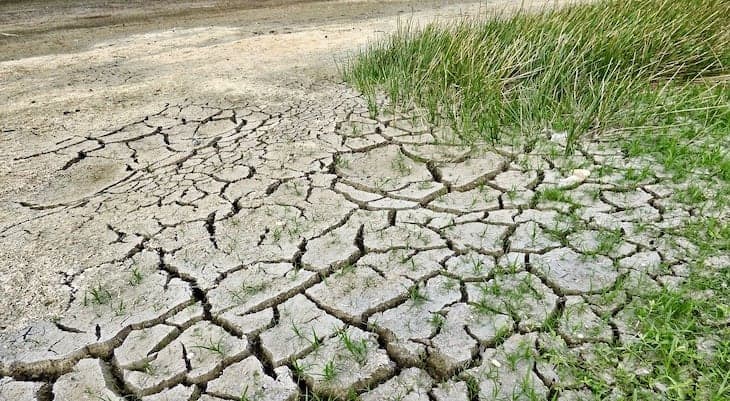
Over-watering waterlogs soil, stresses root systems, and creates conditions that favor fungal growth and disease. Under-watering - often the result of trying to compensate for inadequate pressure rather than genuine conservation - stresses turf, weakens ornamental plantings, and over time destroys the landscape investment the irrigation system was installed to protect.
A VFD-equipped system addresses both problems by delivering controlled, consistent pressure to match field demand - regulated to what the open zones are drawing at any given moment, at a pressure level the infrastructure is designed to handle.
Landscape precision is valuable. Equipment longevity is where the financial case for VFDs becomes compelling.
Every component in an irrigation pump station - motors, pipes, fittings, filters, valves - has a rated service life. That service life assumes the component operates within normal parameters. Fixed-speed startups, pressure surges, and sustained full-speed operation when lower speeds would suffice all push components outside those parameters - not dramatically, but repeatedly, across thousands of operating cycles.
The cumulative effect is premature aging across the entire system simultaneously. It is not unusual to find communities dealing with multiple component failures in quick succession, because the underlying infrastructure has been subjected to the same pattern of mechanical stress for years and reaches the end of its tolerance at roughly the same time.
VFDs interrupt that cycle. By mitigating the startup surge, reducing sustained mechanical stress, and allowing the motor to operate at speeds matched to actual demand, they extend the useful life of motors and components significantly. The pump station that might otherwise require major intervention after ten years of fixed-speed operation has a considerably longer horizon when VFDs are part of the design from the start.
There is a practical financial consequence to this that HOA boards and property managers can calculate directly: fewer emergency callouts, lower repair bills, and longer intervals between major capital expenditure on infrastructure replacement.
Every month, we publish H₂O Zone - a roundup of the latest irrigation, conservation and water news that’s relevant to our Florida client base. To get H₂O Zone emailed direct to your inbox, sign up here.
Every pump motor has what engineers call a Best Efficiency Point, or BEP - the specific point on its operating range where it delivers the most output for the least energy. Run a pump above or below that point, and you are paying for performance you are not getting while simultaneously accelerating wear on the motor. The further a pump operates from its BEP, the greater the waste - in energy, in component life, and in maintenance cost.
This is straightforward enough when you are talking about a single pump. It becomes considerably more complex - and considerably more important - when your pump station runs multiple pumps simultaneously, which is the reality for the vast majority of Florida’s residential communities.
A multi-pump pump station with only one VFD - a setup that is more common than it should be - faces an inherent problem. The single VFD-controlled pump can modulate its speed, but the remaining pumps run across the line: fixed-speed, full RPM, regardless of what demand actually requires. As overall system pressure needs to be maintained, the VFD-controlled lead pump gets throttled back to compensate - taking it out of its BEP. Meanwhile, the other pumps are running at full bore whether the system needs that output or not. The result is a station where none of the pumps is operating efficiently, and the single VFD is doing little more than masking the inefficiency of the overall design.
Per-motor VFDs address this directly. When every pump has its own drive, all motors work in unison - each one modulating its speed in response to overall system demand. In practice, irrigation fluctuation means a multi-pump station will rarely operate precisely at BEP across all pumps simultaneously. But a per-motor VFD design gives the system the best possible conditions for efficient operation, keeping each pump as close to its optimal range as real-world demand allows.
Hoover was one of the first irrigation pump station designers in Florida to specify per-motor VFDs as standard across all of its pump stations. That design philosophy - building a dedicated drive into the station for every pump rather than adding a single VFD as an afterthought - is central to how Hoover achieves the levels of efficiency and reliability their systems deliver in practice.
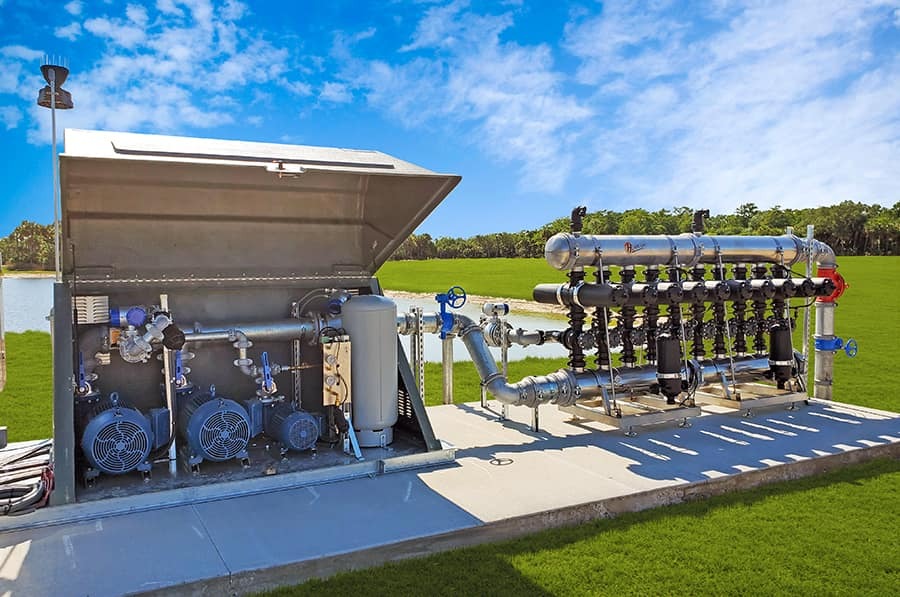
The practical difference between a per-motor VFD design and a single-VFD design is substantial. In a multi-pump station where every motor has its own drive, the drives communicate with one another and share a common frequency, working in synchrony to maintain system equilibrium. Each motor adjusts its speed in step with the others to meet overall system demand - rather than one pump being throttled back while others run at full bore. The result is a station that operates in a coordinated, balanced way that a single shared drive cannot replicate.
Hoover’s position is that this approach - all pumps on dedicated VFDs, designed as a system from the outset rather than retrofitted - delivers efficiency gains of 20 to 50 percent in dynamic operation compared to single-VFD designs where the remaining pumps run across the line. That figure reflects the combined effect of eliminating across-the-line startups, coordinating all pumps toward more efficient operation, and removing the compensatory throttling that degrades performance in single-VFD setups.
A VFD retrofitted to a system that was not designed to accommodate it will deliver some benefits - but it cannot deliver all of them, and it introduces its own complications. The gains available from designing pump and drive together, with the correct specifications for the real-world demands of the community being served, are substantially greater.
It is worth stepping back at this point to connect the technology covered in this article with the monitoring capabilities described in Article 2 in this series.
Hoover Flowguard provides the intelligence layer: continuous visibility of what is happening across the system, automated alerts when behavior deviates from expected parameters, and the remote management capabilities that allow problems to be identified and addressed before they become failures.
VFDs provide the mechanical control layer: the ability to start softly, run efficiently, and match output to demand rather than forcing the system to operate at fixed capacity regardless of conditions.
Together, they represent something more than the sum of their parts - but it is important to understand that each layer addresses a different set of problems. A VFD-equipped system starts more gently and runs more efficiently. What it does not do is prevent rapid cycling - the repeated on-off pump behaviour that gradually damages mainline pipes and drives up repair costs. That is where Flowguard becomes essential. Without intelligent monitoring in place, a system equipped with VFDs but no Flowguard can still suffer the cycling damage that owners were hoping the VFD investment would prevent.
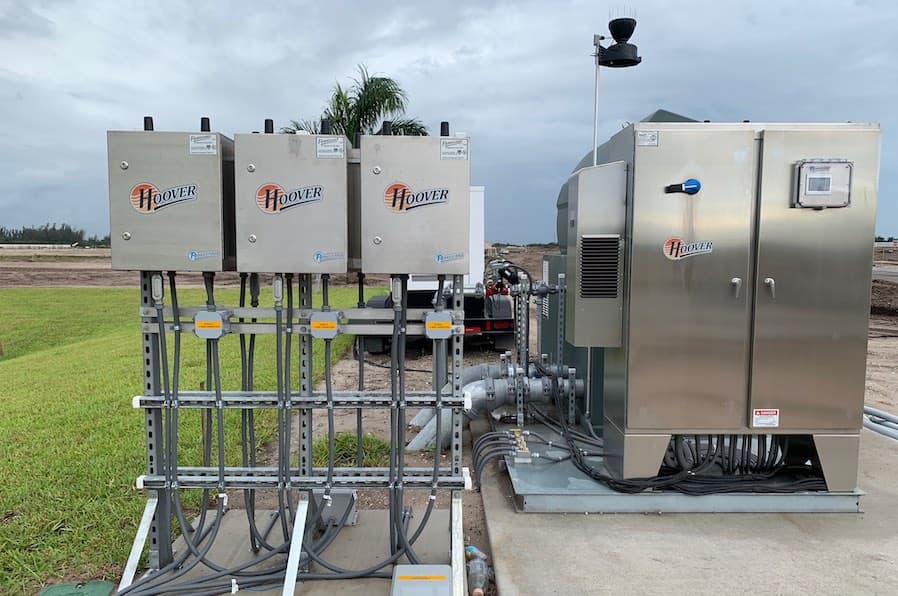
A system with VFDs but without Flowguard has mechanical efficiency - but lacks the data and alert framework that makes genuinely proactive management possible. A system with Flowguard but fixed-speed pumps has visibility - but cannot act on what it sees by modulating pump output. The communities that achieve the most reliable, most cost-efficient irrigation outcomes are the ones where both layers are present and properly integrated - and that integration is what the Flowguard platform is designed to deliver as a single, fully supported solution.
For HOA boards and property managers, the case for VFDs ultimately comes down to a straightforward calculation. A pump station without them is running harder than it needs to, wearing faster than it should, and delivering water less precisely than your landscape requires. The energy it consumes in excess of actual demand is money spent with no return. The mechanical stress it generates with every startup is a future repair bill being written in advance.
A pump station where every motor runs on its own dedicated VFD - properly specified and built to work as an integrated system - changes that equation entirely. It starts softly, runs efficiently, keeps every pump operating as close to its best efficiency point as field conditions allow, and delivers better results for the landscape it serves, across a longer service life.
That is not a complicated argument. It is simply what good engineering looks like when it is applied to the specific demands of Florida’s irrigation environment.
Every month, we publish H₂O Zone - a roundup of the latest irrigation, conservation and water news that’s relevant to our Florida client base. To get H₂O Zone emailed direct to your inbox, sign up here.


800.548.1548
2801 N Powerline Road Pompano Beach, FL 33069


© 2026 Hoover Pumping Systems Corporation. All rights reserved.