
Updated 7 May 2026
The annual cost of running irrigation pumps is calculated using the formula $/yr = $/kWh × kWh/AF × AF/yr - your electricity rate multiplied by pump energy use per acre-foot, multiplied by total acre-feet delivered per year. To reduce costs, you can negotiate a better rate schedule with your utility provider, improve your pump's Overall Pumping Efficiency (OPE), or reduce the volume of water pumped through smarter irrigation scheduling.
So, how much energy does it take to move water around an irrigation system?
A major chunk of the annual cost of the water delivery systems for irrigation can be attributed to running the pumps. Even now, with so many other power sources, the majority of pumps requiring energy in to move water around an irrigation system are powered by electricity - and electricity has a cost.
Most HOAs will know their irrigation running costs overall - or at least know the budget that's been allocated and what they spend each year. Finding out exactly how much budget is being used on the energy to move water from source to sprinklers will help inform decision-making and could even free up budget for other expenses. Whether a community sits on 40 acres or 1400 acres, working out how much energy it's taking to run the irrigation pumps (the irrigation cost per acre) will point to the operating efficiency of your pump or pumps.
If you have a pump installed and an already established irrigation system, you'll know that energy costs vary from season to season, and on top of that, you'll have maintenance and repairs that also vary from season to season and year to year.
It is possible to get a clearer picture of the energy costs a system is consuming in order to transport water. Contributing to this picture, of course, is how much water is being delivered to the landscape. Here are some figures for you: to provide lawn and planted areas with a 1-inch depth of water you'll need to irrigate at a rate of half a gallon per square foot. If you consider this figure in terms of acreage, to irrigate an entire acre to a depth of 1-inch requires just over 27,154 gallons of water! To irrigate an acre to a depth of 1-foot all over (known as an acre-foot or AF) requires about 325,851 gallons of water. (For ease of reading, we've created a short glossary of terms at the end of this post).
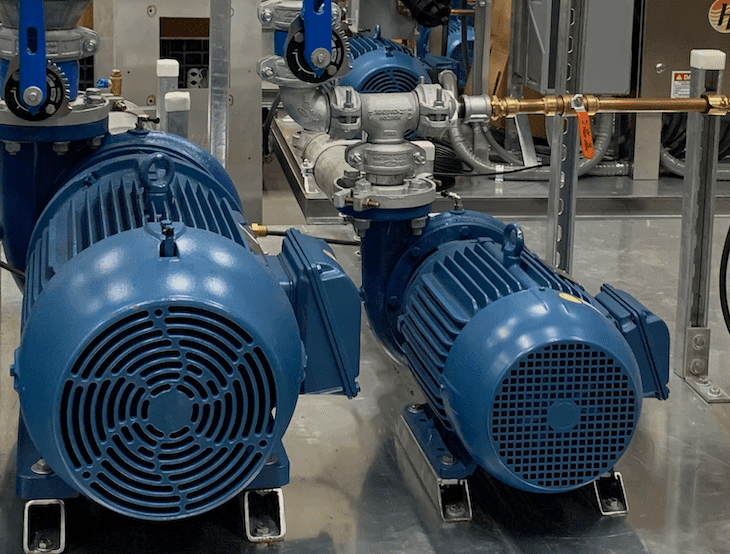
There are several ways to minimize the average cost of electricity per kilowatt-hour. It all depends on power usage, and that means figuring out when you use power and for how long.
The Math
$/yr = $/kWh x kWh/AF x AF/yr
The annual cost of electricity is equal to the amount paid per kWh multiplied by the kWh used per acre-foot multiplied by acre-foot of water delivered per year.
For the Non-Mathematicians
The equation above shows that to lower annual costs of pumping you can lower the energy cost per unit ($s per kWh), lower the kWh required to deliver each AF, or simply reduce the number of AF you pump each year.
A range of electricity rate schedules are offered to different user-types. If you haven't looked at the rate schedule you are on for a while, it's worth checking - and if you've never looked at the rate schedules on offer, have a conversation with your utility provider as a matter of priority.
A common rate schedule available is "Time of Use". So not pumping during peak hours makes sense and reduces your costs.
Some utilities provide an interruptible service option where the average $/kWh is lowered to the customer based on the customer agreeing to refrain from using electricity during critical energy-supply situations.
Improve pumping efficiency and you'll lower energy consumption and therefore, energy costs.
The Math
Annual energy costs (electricity measured in kWh) for an irrigation water pump can be calculated using the following equation:
kWh/AF = 1.0241 x TDH / OPE
This equation represents a method for estimating pumping station energy use.
On one side is the kWh required to pump an acre-foot of water through the pump station and on the other, the means to arrive at the estimated energy consumption. This uses the recognized conversion constant for water at standard conditions (1.0241) multiplied by the total lift (known as total dynamic head or TDH) developed by the pumping station in feet, divided by the overall pumping efficiency (OPE).
For the Non-Mathematicians
Even if you know nothing about basic fluid dynamics you can easily work out the costs by punching the figures into the equation above. To put it simply, the equation shows that reducing energy usage per acre-foot is down to the hardware and management.
In other words, consumption of energy is governed by the design of the system (which gives the figure for TDH) and the design efficiency of the irrigation pumping station (which leads to the figure for OPE). An additional impact on OPE and therefore energy use is the management of the irrigation generally. Poor management results in a decrease in irrigation efficiency. With a decrease in efficiency comes a corresponding increase in the AF per year (the volume of water pumped). The best irrigation pump in the world is useless if managed badly!
Energy efficiency in pumping is affected by different issues and diffuse sources in varying combinations. An example combination could be the rate schedule you're on, the pressure in the pump system and the operational efficiency of your pump.
Choice of irrigation pump design, decisions about testing and maintenance and decisions around operations are all management actions. To affect improvements, management decisions have to be made - responsibility has to be taken for a problem, and when solutions are found, resources must be available to carry out those solutions.
Here's how the interaction between these three management components could look. If a pump is in place, (1) testing it regularly for efficiency will (2) identify the OPE, and the data provided (3) can provide insights and actions for an HOA board.
Awareness of available solutions is key but it's not always clear what a solution might be. A pump operator will know whether or not an irrigation pump can be repaired, but if part of the problem is excessive drawdown in a well, as a member of an HOA board you're not necessarily going to know how to deal with that.
From fixing system leaks and resetting pressure-regulating valves to replacing an incorrectly matched part in the system and fine-tuning irrigation scheduling, all these solutions can result in improvements. However, there is one major contributor to irrigation efficiency today that can have a major positive impact on efficiency. This comes from the smart irrigation technologies that constantly monitor the pump station and the system, providing huge amounts of detailed information about performance.
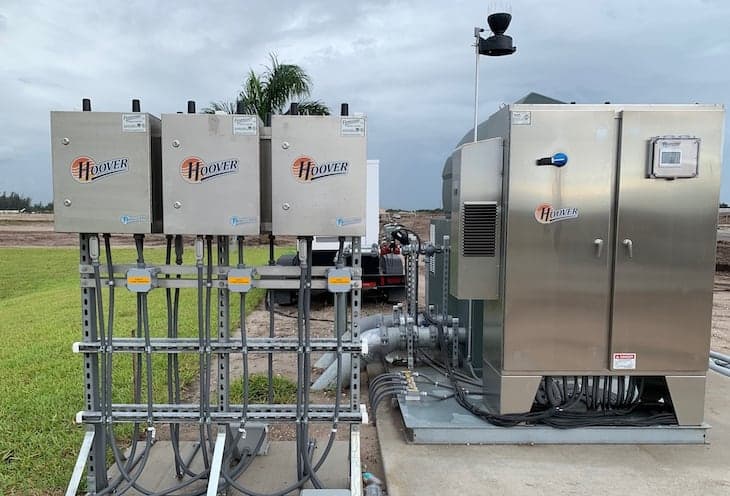
Alerts can be sent out that pre-empt small issues turning into big problems. If you get an email from the system that says "Hey, a pump is trying to pull water but it can't for some reason, possibly excessive encrustation and grime. Go check it out!" you can troubleshoot very quickly. Here's another one. A typical design has a magnetic flow meter monitoring the water, and in combination with a shut-off valve, you have the ability to shut things down remotely when there's a problem. So if someone with a backhoe hits the irrigation line and water starts flowing everywhere - the smart irrigation technology allows the valve to be shut off instantly to minimize any kind of damage - and they're not going to wash out a parking lot or someone's backyard!

A well-designed and manufactured irrigation system, from the irrigation pump station, with skid and deck hot-dip galvanized, copper pipe for the tank, no painted surfaces, stainless steel panels and so on, to self-cleaning rotating screens and stainless steel air conditioner for the panels that control all the electronics, should last a minimum of 20 years out in the field even in a very extreme environment like South Florida.
It will also play a major part in ensuring your irrigation operation is as energy efficient as it can be, with the ability to constantly monitor and pick up issues before they become insurmountable problems.
TDH - Total Dynamic Head
This is the total pressure developed by the system, i.e., the work done by the pump. Water is a relatively incompressible fluid and when pumping water, TDH is the pressure head difference between the inlet and outlet of the pump.
There are several TDH online calculators available for you to try, here's one on the WSU website.
OPE - Overall Pumping Efficiency
This is a measure of the pump performance using the three parameters of flow, pressure and energy consumption.
kWh - Kilowatt Hour.
The total amount of electricity going through an electric meter to run (in this case) a pump for a period of 1 hour. The numbers on the meter are what your utility company base your charges on.
AF - Acre-Foot.
This is a unit of volume referring to large scale water resources. It is the amount of water required to cover an acre of land to a depth of one foot. An acre-foot is about 326,000 gallons.
Use the formula: $/yr = $/kWh x kWh/AF x AF/yr. Your annual pumping cost equals the amount you pay per kilowatt-hour, multiplied by the kilowatt-hours required to deliver each acre-foot of water, multiplied by the total acre-feet pumped per year. To reduce costs, you can lower your electricity rate, improve pump efficiency, or reduce the volume of water pumped.
Pump energy use is calculated using: kWh/AF = 1.0241 x TDH / OPE. This estimates the kilowatt-hours required to pump one acre-foot of water, based on the recognised conversion constant for water (1.0241), the Total Dynamic Head (TDH) developed by the pump station in feet, and the Overall Pumping Efficiency (OPE). A higher OPE means lower energy consumption for the same volume of water delivered.
Overall Pumping Efficiency (OPE) is a measure of pump performance calculated from three parameters: flow, pressure, and energy consumption. The higher the OPE, the less electricity is needed to move water through the system. Poor irrigation management — such as running pumps outside their optimal range or ignoring maintenance — reduces OPE, which directly increases energy costs.
Yes. Utility providers offer different rate schedules, and many commercial irrigation customers are not on the most cost-effective one for their usage pattern. A Time of Use schedule, for example, charges less during off-peak hours — so scheduling pumping outside peak demand periods can meaningfully reduce costs. Some utilities also offer interruptible service rates with a lower $/kWh in exchange for agreeing to suspend use during critical supply situations. It is worth reviewing your current rate schedule and discussing options with your utility provider.
Smart irrigation systems continuously monitor pump station performance and flag issues before they escalate into costly failures. Sensors and alerts can detect problems such as pump inefficiency, blockages, or line breaks early, allowing fast intervention that prevents wasted water and energy. Remote shutoff capability — for example, closing a valve instantly if an irrigation line is damaged — also prevents large-scale water loss that would otherwise inflate both water and energy bills.
Irrigating one acre to a depth of one inch requires approximately 27,154 gallons of water, which works out to half a gallon per square foot. To irrigate an entire acre to a depth of one foot — known as an acre-foot — requires around 325,851 gallons. These figures illustrate why even small improvements in pump efficiency or scheduling can produce significant reductions in both water and energy consumption at scale.
pdf Download This Article Here!(1.23 MB)



800.548.1548
2801 N Powerline Road Pompano Beach, FL 33069


© 2026 Hoover Pumping Systems Corporation. All rights reserved.